
Picture from Roman on Unsplash
Like everybody else, I followed the formality. Festivities and confetti. Happy New Year? Not really. I didn't celebrate, and though it wasn't a deliberate choice, I enjoyed using that time the way I wanted to: resting and relaxing. Over the last few years, I've become more attuned to my inner rhythms, and it was obvious I needed to slow down.
Over time, layers of shame and guilt started melting. The shame of being inconsistently productive, of treating my body like a machine. The guilt of wanting to rest and nap in the middle of the day. And as false identities like "high achiever" or "doer" thawed, it felt like a tremendous loss. They gave me the illusion of control. But in the end, it was just that: an illusion.
Because somehow, through knowledge, technology, and sheer will, I believed I could override my biology. Override the realization that I was here, in a world that felt daunting, unsafe: an earth that didn't feel like home. Like a cosmic orphan dropped in the middle of nowhere, still waiting for her parents to pick her up. Waiting to be saved from this reality called the human condition. And because I was constantly dreaming of somewhere else, I was never present—somehow in the clouds, disconnected and impalpable.
I moved and worked at a relentless pace, chasing intensity to feel alive. All I knew was survival. After spending time with my Congolese aunty and grandpa, I realized I wasn't truly living. In search of answers, I turned to the precolonial history of the Democratic Republic of Congo and discovered the Bakongo people and their spiritual cosmology, the Dikenga.
Dikenga & the Four Movements of Life
In Kikongo, Dikenga means 'the turning' and represents a sun cross: one of humanity's oldest sacred symbols. This ancient symbol consists of a circle containing an equilateral cross that divides it into four separate quadrants. Each quadrant is associated with the four phases of the sun and four cycles of life.
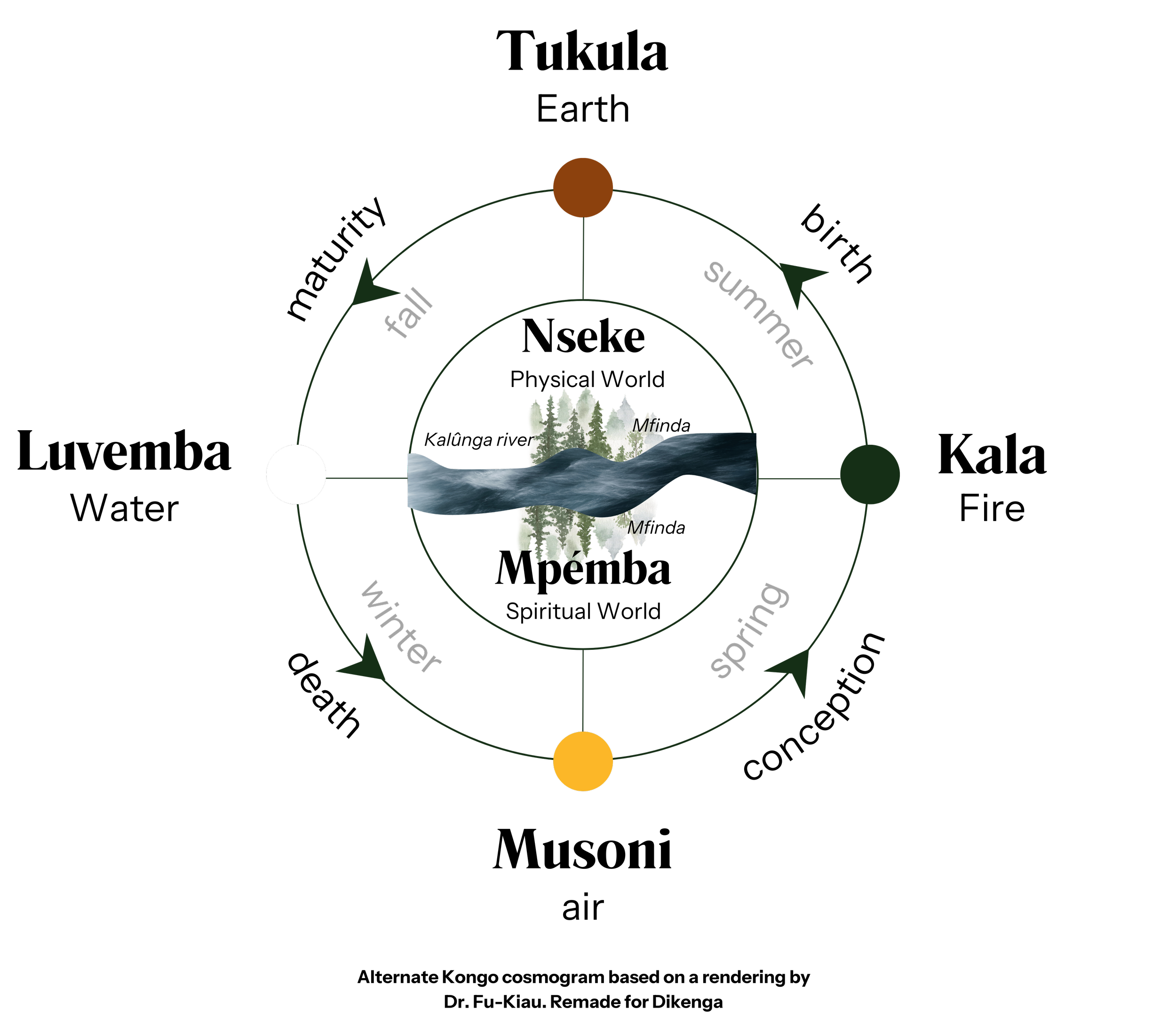
The journey begins in the east with Kala, the dawn of new beginnings, where birth ignites through the element of fire. Moving to Tukula, the sun at its zenith, where maturity grounds itself through the earth element—embodying a powerful presence in the physical world. In the west, Luvemba marks the late afternoon, a time of reflection and preparation for the cycle's end, where death flows through the element of water. Finally, Musoni, the midnight hour in the south, holds conception and gestation before rebirth: a place of pure potential from which new life emerges through the element of air.
I had been living in Tukula: overachieving, performing, grounded in material success. But I was being pulled toward Luvemba, the descent, the water time. I was resisting my own sunset. But to the Bakongo, time is an ever-flowing cyclical river marked by "dams of time" called "n'ka-ma mia ntangu" in Kikongo. Those dams are natural, biological, or human-made events that create periods of time. The four phases of the sun cross were not cycles measured by a clock, but rather four different realms of time, each flowing with its own rhythm.
More than a symbol, the Bakongo used it as a cosmogram, a way to understand the cosmos and our role within it. To them, the Kalunga river is the main source of all creation, considered as cosmic time itself. This powerful current creates new landmarks along its way and is also known as the fiery spark that created the universe. Understanding this changed everything.
What if my exhaustion wasn't failure, but an invitation to cross into another phase? What if I already knew what time it was?
The four cycles helped me understand my own rhythm but not why this time felt so final. Why it felt like the end of something much older than me: an end to repeating patterns, to descending cycles, to ancestral karma.
Collapse & Symbolic Death
Through the four cycles of life, we understand that the collapse we're experiencing is not only natural but something we've been preparing for. The Kongo people read the Dikenga clockwise or counterclockwise, and its deeper meaning unfolds in the myth of Mahûngu.
Mahûngu, the first being created by the supreme God Nzambi a Mpungu, was androgynous. He embodied wholeness through the symbiosis of creation and destruction, existing in pure happiness without suffering or hatred. Mahungu lived beside a sacred palm tree, forbidden to circle. Out of curiosity, he walked clockwise around it and found himself split into two: Lûmbu, the man, and Muzita, the woman. Both had lost their divinity and sense of wholeness. They tried walking counterclockwise to regain what was lost, but nothing worked. Marriage became the only way to approach that sacred union again. As humanity expanded, this separation consciousness deepened our suffering and chaos.
The myth reveals something crucial: the fall is a clockwise movement. Ascension must be counterclockwise, but not through human effort alone, it requires spiritual surrender. The creator had to descend and repel the darkness through the power of divine love. Since human beings have free will they could accept or refuse this light. Those who accepted crossed the Kalunga line toward Kala time, beginning an initiation: a symbolic death. It consisted in a purification from material attachments and a return to the community to share what was learned.
This is the collective initiatory process we're moving through now. We can choose to follow this ascension of consciousness, accepting its call to symbolically die and release old ways of being. Or we can remain in the descending cycles. My own initiation came last year through a potentially fatal blood illness called TTP. It is a chaotic dysfunction of the coagulation system where the blood does both extremes at once: bleeding too much while forming too many clots. My body had lost its ability to coagulate properly, to find balance between dissolving and forming.
I underwent multiple plasmapheresis treatments, a process that removes and replaces the plasma. Referred to as liquid gold, cleaned plasma supports our natural abilities to renew and regenerate ourselves. The treatment felt alchemical, as if I was releasing chaos to make space for something divine to flow through me again. To heal, I had to release what no longer served me: rage, deep sadness, inherited pain.
The purification was ancestral, not just medical. I had to symbolically die to who I thought I was. All the different versions of myself scattered through time are now integrated. I can observe them simultaneously, as if standing at the center of the spiral where all times coexist. The initiatory crossing wasn't abstract—it happened in my blood, in my physical vessel and the learning to take form again.
Sacred Scroll & Living Codes
Surprisingly, being here feels peaceful. A calm I didn't know I could inhabit. A calm coming from my ability to accept and see the beauty of this world and the human condition as well as its tragedies.
Dying symbolically is confronting, and most people would rather avoid looking at their pain because of the courage it requires. We'd rather self-soothe the way we know how and chase temporary highs. And for many of us, it's through doom scrolling. Scrolling to kill boredom and avoid what is. Scrolling to forget the pain of yesterday, escape the discomfort of today, and avoid the fear of tomorrow. Perpetually fueling our distortion of time.
But for the Bakongo, the past, present, and future are part of the same thread, and we are holding all of these times in our hands simultaneously. They perceive time as a scroll. To be "on time" for them meant being able to move freely through the past by unrolling the scroll, returning to the present, and allowing the future to reveal itself through the natural unfolding process.
When I discovered the Dikenga, I didn't just find ancestral knowledge: I activated it. The scroll they protected through centuries of colonization, war, and attempted erasure was encoded in my DNA all along, waiting to be turned on. I began traveling consciously through time, returning to childhood wounds, adolescent grief, even back to the 17th century witch hunts carried in my lineage. Each journey reprogrammed my genetic memories, deactivating toxic ancestral patterns and reactivating dormant codes of healing.
The TTP wasn't just a breakdown but a call for evolution. My body wasn't malfunctioning; it was recovering at such an intense level that the coagulation system couldn't keep up with the transformation. The golden plasma I received carried new information, new codes. What looked like illness was my body remembering how to regenerate, how to activate the natural human capacities we've forgotten: clair senses, cellular regeneration, time traveling through our DNA. A body intelligence surpassing any man-made technology.
Time travelers have always existed. I think of JDilla, the legendary producer who died from the same blood illness that initiated me. His music lives in what musicians call "Dilla time"—beats that fall intentionally off the grid, creating a rhythm so alive. Perhaps he knew that being on time has nothing to do with the clock.
I once felt like a cosmic orphan, refusing to land because this world felt too harsh. But what I was really running from wasn't the world, it was the love emanating from me. An intensity that seemed to scare people away, when the person truly terrified was me. Deep inside, I knew that fully embodying this energy could create magic, miracles. And that felt too powerful, too much.
My initiation wasn't just about remembering love. It was about learning to incarnate it. To let the love that flows through our lineages, finally take form in my body without running or dissolving.
We are living through a collective initiation, and it's asking us one question: will we take the invitation and choose love over fear? The energy of union. Of coming back together after the fall, after the division, after forgetting who we are. This love has always been present. In every era, through every darkness, it remains: timeless, unbreakable. The scroll our ancestors protected wasn't just knowledge. It was a letter, written in blood and time, reminding us of what we've always been.
The expression of love.
***
Sources:
K. K. Bunseki Fu-Kiau. 1994. Ntangu-Tandu-Kolo: The Bantu-Kongo Concept of Time
K. K. Bunseki Fu-Kiau. 2014. African Cosmology of the Bantu-Kongo: Tying the Spiritual Knot, Principles of Life & Living.